It took three hours for Pat to find the courage to get out of her son’s car on Hopetoun Street and make it through the doors of our Women’s Mental Health Centre late last year.
Crippled with anxiety, her mind racing, and severely sleep deprived, the mum-of-four couldn’t see how we could be of help until one of our psychiatrists sat her down and convinced her that this – Australia’s first women-only mental health hospital – was exactly where she needed to be.
“I eventually made it through the doors,” Pat said. “I was very ill, and even though there was nothing appealing to me about the thought of staying in a mental health hospital, I realised it was the right thing to do. I had to hold onto something, so I thought if they're going to send me to a facility, at least I knew that being in a women’s-only place I would be safe.”
In January, research published in the journal Australasian Psychiatry found that the specialised, trauma-focussed, holistic model of care that Cabrini developed for women’s mental health is not only effective but it can feasibly be reproduced.
“We’ve had a number of other centres from around the world visit our hospital to learn from us and use our model as a template.
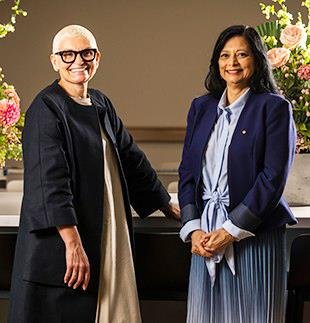
“The whole program is built on dealing with and helping people through trauma in a women-only setting… and the biological aspects that are different for women – the hormone-related issues,” Centre founder Professor Jayashri Kulkarni said.
“The idea of women’s mental health needing a separate understanding and attention paid to safety and privacy is catching on.”
Cabrini Chief of Mental Health, Sharon Sherwood, said the published data collected from the hospital’s first three years testifies to the Program’s success.
“Our guiding principle is that women experiencing significant mental illness will have a better response to treatment and better outcomes when they receive treatment in a safe, women-only facility, and that treatments and programs are targeted to meet the needs of women and tailored for their specific illness, with true recognition of violence and trauma in all its forms, and with consideration of the biological factors that affect women’s mental health,” Sharon said.
“That 95 per cent of the almost 1000 patients who we surveyed said they felt safe in our hospital’s care, and that 93 per cent of those surveyed said the quality of care was excellent and they would refer someone who needed psychiatric care, shows that this model really does work.”
For Pat, who has experienced multiple traumas throughout her life, her 14-day stay was challenging but life-changing and she’s now “feeling much better at being able to deal with the world”.
“I don't have the words for what it did, so I’ll just call it an absolute miracle,” Pat said. “From where I was to where I am now, it’s given me back my life in every respect.
“My daughter convinced me to come here by saying that this place would give us a bit of hope that I could be well again, but I think we've got a bit more than that. My son Josh said we didn’t just get our mum back; we got a better version of our mum.”
~ submitted by Margaret Stewart, Group Director, Identity and Mission, Cabrini Health, AUS
COMMENTS